
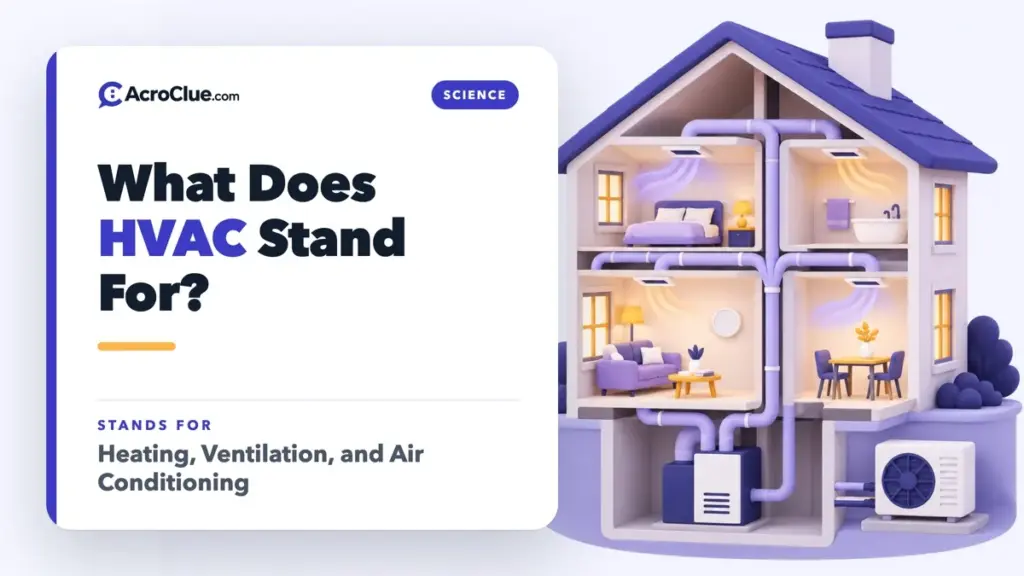
You spot “HVAC” on a home listing, a repair quote or a job ad, and the four letters tell you nothing. Guess wrong and you could pay for the wrong repair or pass on a solid trade career. So, what does HVAC stand for? Here is what HVAC stands for, what each letter covers, how it differs from plain AC, and where the term came from.
What Does HVAC Stand For?
The short answer: HVAC stands for heating, ventilation, and air conditioning. The term covers the equipment that warms, cools and freshens the air inside a building, and the trade that installs and repairs it. Furnaces, heat pumps, air conditioners, fans, ducts, filters and the thermostat all work as parts of one HVAC system.
Major dictionaries give the same HVAC meaning, with one small twist in the wording. Merriam-Webster lists both “heating, ventilating, and air-conditioning” and “heating, ventilation, and air-conditioning.” Oxford Learner’s Dictionaries labels the abbreviation as especially American.
ASHRAE, the engineering society for heating and cooling, uses the “ventilating” form. Its free online glossary describes an HVAC system as three things working together: the machines, the ducts or pipes that move air or water, and the vents or radiators that finish the job in each room.
What Does Each Letter in HVAC Mean?
Each letter in HVAC names a job, except the last two, which share one. H is for heating and V is for ventilation, while A and C together mean air conditioning. So there are four letters, but HVAC stands for only three jobs: warming the air, freshening it and cooling it.
- H for heating: a furnace, boiler or heat pump adds warmth when it’s cold outside.
- V for ventilation: fans, ducts and exhaust vents bring in outdoor air and push stale air out. ASHRAE defines ventilation as supplying air to a space, or removing it, to control pollutants, humidity or temperature.
- AC for air conditioning: in everyday talk, this means cooling. In ASHRAE’s technical definition, air conditioning means treating air to control its temperature, humidity, cleanliness and movement through a space.
That last point explains a lot. To an engineer, air conditioning never meant only cold air. Willis Carrier designed his first system to control humidity in a printing plant, as the next section shows.
Where Did the Term HVAC Come From?
The name HVAC joins three older trades. Heating and ventilating engineers formed a national society in 1894, Willis Carrier’s first modern air-conditioning system followed in 1902, and Stuart Cramer coined the phrase “air conditioning” in 1906. The four-letter abbreviation came later: Dictionary.com dates its first recorded use to 1940–45.
The heating side organized first. The American Society of Heating and Ventilating Engineers held its founding meeting on September 10, 1894, ASHRAE’s history pages record. Refrigerating engineers started a society of their own in 1904.
Air conditioning began as a fix for paper, not people. On July 17, 1902, Carrier designed a system for the Sackett & Wilhelms printing plant in Brooklyn, where damp air made paper swell and colors print out of line. Carrier’s history of the first modern air conditioner says chilled coils, fans, ducts, heaters and moisture pipes then held the plant at a steady 55 percent humidity.
The name came four years later. In May 1906, Stuart W. Cramer, an industrial engineer, used the phrase “air conditioning” in a speech in Asheville, North Carolina, before the American Cotton Manufacturers Association. Both Carrier and North Carolina’s Department of Natural and Cultural Resources credit him with coining it.
Cramer had been adding moisture to the air in textile mills since 1895 to keep threads damp, a practice known as yarn conditioning. His new term reached further, taking in fresh air, clean air and drier air. Carrier’s engineers soon picked up the phrase too.
| Year | Milestone | Source |
|---|---|---|
| 1894 | The American Society of Heating and Ventilating Engineers holds its founding meeting (September 10). | ASHRAE’s history pages |
| 1902 | Willis Carrier designs the first modern air-conditioning system, for a Brooklyn printing plant (July 17). | Carrier’s history page |
| 1904 | The American Society of Refrigerating Engineers forms. | ASHRAE’s history pages |
| 1906 | Carrier receives a patent for his “Apparatus for Treating Air” (January 2), and Stuart Cramer coins “air conditioning” (May). | Carrier’s history page; North Carolina Department of Natural and Cultural Resources |
| 1940–45 | The first recorded use of the abbreviation HVAC. | Dictionary.com |
| 1959 | The heating and refrigerating societies merge to form ASHRAE, short for American Society of Heating, Refrigerating and Air-Conditioning Engineers. | ASHRAE’s history pages |
| 2012 | ASHRAE starts doing business under its acronym alone. | ASHRAE’s history pages |
| 2023 | The U.S. Department of Energy changes how HVAC systems are tested, and cooling ratings move to SEER2 (January 1). | U.S. Department of Energy |
How Does an HVAC System Work?
Every HVAC system does two things: it makes or moves heat, and it moves air. A furnace, boiler or heat pump adds heat, and an air conditioner or heat pump pulls heat out. Fans and ducts carry air from room to room, an air filter cleans it, and a thermostat tells the whole system when to run.
- Heating equipment. A furnace warms air and blows it through ducts. A boiler heats water that flows through pipes to radiators, and a heat pump moves heat indoors instead of burning fuel. Common fuels include natural gas, propane, heating oil and electricity.
- Cooling equipment. An air conditioner or heat pump circulates a refrigerant that soaks up heat at an indoor coil and releases it at an outdoor coil. Cooling the air also pulls moisture out of it.
- Ventilation. Fans, exhaust vents and fresh-air intakes swap stale indoor air for outdoor air.
- Air distribution. Ductwork and vents, or pipes and radiators, carry heat or cool air to each room.
- Filters. The filter catches dust and other particles before the air goes back into the rooms.
- Controls. The thermostat turns the equipment on and off. ASHRAE defines an HVAC zone as a space where one sensor, such as a thermostat, can hold the same conditions throughout.
Homes mix and match these parts. Two-thirds of U.S. households cool with central air conditioning or a central heat pump, the U.S. Energy Information Administration (EIA) reports. Others use window or wall units, mini-splits or portable units.
HVAC vs AC vs HVACR: What Is the Difference?
AC means air conditioning, the cooling part of the system. HVAC stands for the whole package of heating, ventilation and air conditioning, and HVACR adds refrigeration, such as the cold cases in a grocery store. Every AC unit counts as HVAC equipment, but HVAC covers far more than AC.
| Term | Stands for | What it covers | Where you’ll see it |
|---|---|---|---|
| AC or A/C | Air conditioning | Cooling and drying indoor air in everyday use; to engineers, control of temperature, humidity, cleanliness and air movement | Thermostat settings, car dashboards, apartment ads |
| HVAC | Heating, ventilation, and air conditioning | Heating, fresh air and cooling for a whole building | Home listings, contractor quotes, job ads |
| HVACR (also HVAC&R or HVAC/R) | Heating, ventilation, air conditioning, and refrigeration | HVAC plus commercial refrigeration in grocery stores, hotels and restaurants | Federal job data, trade school programs, ASHRAE |
| HVAC (power grid) | High-voltage alternating current | Sending electricity over AC power cables, such as offshore wind export lines | Grid and offshore wind plans |
| HVDC | High-voltage direct current | Sending large amounts of power over long distances with lower losses | Grid and offshore wind plans |
The U.S. Bureau of Labor Statistics (BLS) describes the work as HVACR and notes that people often call these workers HVAC technicians. ASHRAE writes HVAC&R. Some technicians specialize in commercial refrigeration for grocery stores, hotels and restaurants, but the core training covers heating, cooling and refrigeration together.
What Does HVAC Stand For in a Car?
In a car, HVAC stands for the same three words: heating, ventilation, and air conditioning. It is the climate control system for the cabin, made up of the heater, the blower fan and vents, and the A/C. It works much like a home system, only with smaller parts packed behind the dashboard and under the hood.
A car heater borrows heat from the engine. Hot coolant flows through the heater core, a part inside the dashboard, and the blower pushes air across it and out of the vents, SlashGear explains.
The A/C pumps refrigerant through a loop that includes a compressor, a condenser, an expansion valve and an evaporator. Only the evaporator, the expansion valve and the blower sit behind the dash; the rest live in the engine bay. So when a mechanic says your HVAC needs work, ask which part: the heater, the blower or the A/C.
Does HVAC Have Any Other Meanings?
Yes, one. In power engineering, HVAC stands for high-voltage alternating current, one of two main ways to move large amounts of electricity through cables. The other is HVDC, high-voltage direct current. Outside the power grid, though, HVAC almost always means heating, ventilation, and air conditioning.
Offshore wind developers choose between the two when they run export cables to shore. The Mid-Atlantic Ocean Data Portal, run by the Mid-Atlantic Regional Council on the Ocean, says HVDC cables carry more power over longer distances. HVAC cables usually cost less for wind farms within 60 nautical miles of shore.
Context tells you which meaning you have. On a building plan or a home inspection report, HVAC stands for the heating and cooling equipment. On a grid study that also lists cables, substations and megawatts, it means high-voltage alternating current.
What Does an HVAC Technician Do?
An HVAC technician installs, maintains and repairs heating, cooling, ventilation and refrigeration systems in homes, schools, hospitals and other buildings. The BLS counted about 440,900 of these jobs in 2025 and expects employment to grow 11 percent from 2025 to 2035, much faster than the average for all jobs.
On a job ad, HVAC stands for the trade as much as the equipment. Day to day, technicians inspect and test systems, replace worn parts, install electrical parts and wiring, explain problems to customers, and keep records of each job. The BLS puts their median pay at $61,010 a year in May 2025.
Here is the usual path into the trade:
- Training. Programs at trade schools and community colleges last 6 months to 2 years and end with a certificate or an associate’s degree. Some people learn through a paid apprenticeship instead, which usually lasts several years.
- EPA certification. Nearly every HVAC technician needs EPA certification to handle refrigerant, the BLS says. The EPA’s Section 608 certification rules, set under the Clean Air Act, apply to anyone who maintains, services, repairs or disposes of equipment that could leak refrigerant into the air.
- A state or local license. Some states and cities require one, so check the rules where you plan to work.
The Environmental Protection Agency offers four types of Section 608 certification: Type I for small appliances, Type II for high-pressure and very high-pressure equipment, Type III for low-pressure equipment, and Universal for all of them. The certificate never expires. This guide explains the term only, so for refrigerant work or gas furnace repairs, hire a licensed, EPA-certified technician.
Why Does HVAC Matter for Your Home?
HVAC matters because heating and cooling use more of a home’s energy than anything else. The EIA found that space heating and air conditioning made up 52 percent of the average U.S. household’s yearly energy use in 2020. EIA data from that year also show that 88 percent of U.S. households use air conditioning.
That makes your HVAC system worth a little attention. Three habits pay off:
- Check the filter. The EPA’s MERV scale, short for Minimum Efficiency Reporting Value, rates filters from 1 to 16 on how well they catch particles. For an upgrade, the EPA suggests MERV 13 or higher, or the best rating your system’s fan and filter slot can handle.
- Book regular service. A service plan usually covers inspecting the system, cleaning ducts, replacing filters and checking refrigerant levels, the BLS notes.
- Read the efficiency label. Air conditioners list a SEER2 rating, heat pumps add HSPF2 for heating, and furnaces and boilers show AFUE. A higher number means more heating or cooling from the same energy.
Home buyers can put the term to work too. On a listing, HVAC stands for the whole system, so “new HVAC” should mean new heating and cooling equipment, not just a new thermostat. Ask the seller which parts they replaced and when.
How Do You Say and Write HVAC?
Merriam-Webster gives one pronunciation for HVAC: “AYCH-vak.” Dictionary.com lists that and the letter-by-letter “aych-vee-ay-see,” so both are correct. In writing, use capital letters with no periods, and put “an” in front of it, as in an HVAC repair or an HVAC technician.
The two ways of saying it make HVAC a bit of both kinds of abbreviation. Spelled out letter by letter, it works like an initialism, the way you spell out DDS, the degree after a dentist’s name. Said as “AYCH-vak,” it acts more like an acronym you read as a word, such as RACE, the classroom writing strategy.
- Capitals, no periods: write HVAC, not H.V.A.C. or Hvac.
- “An,” not “a”: the letter H starts with a vowel sound (“aych”), so write “an HVAC system.” The BLS writes “an HVAC technician” too.
- Ventilation or ventilating: both appear in major dictionaries. Pick one and use it the same way throughout.
- HVACR, HVAC&R or HVAC/R: all three add refrigeration. Follow the form your school, employer or client uses.
However you say it, HVAC stands for the same three words.
Related Acronyms You’ll See Next to HVAC
Once you know what HVAC stands for, the other letters on a quote or spec sheet get easier to read. Common ones include the efficiency ratings SEER2, HSPF2 and AFUE, the MERV filter scale, IAQ for indoor air quality, and BTU for heating and cooling output. Here is what each one means.
- SEER2: Seasonal Energy Efficiency Ratio, the cooling rating for central air conditioners and heat pumps under the DOE testing rules that took effect on January 1, 2023.
- HSPF2: Heating Seasonal Performance Factor, the heating rating for heat pumps.
- AFUE: Annual Fuel Utilization Efficiency, the share of a furnace’s or boiler’s fuel that turns into heat.
- MERV: Minimum Efficiency Reporting Value, the 1-to-16 filter scale, based on an ASHRAE test method.
- IAQ: indoor air quality, or how clean and healthy the air inside a building is.
- BTU: British thermal unit, the unit for heating and cooling output.
- HVACR: HVAC plus refrigeration.
Common Mistakes and Myths About HVAC
A classic mistake is treating HVAC as a fancy word for air conditioning. HVAC stands for three jobs, and a furnace that never cools a thing still counts as HVAC equipment. Other slips include giving one inventor all the credit, mixing up HVAC and HVACR, and missing the power-grid meaning.
- Myth: HVAC just means AC. Air conditioning is one of three parts. Even the term “air conditioning” means more than cooling in ASHRAE’s definition.
- Myth: Willis Carrier invented HVAC. Carrier built the first modern air-conditioning system in 1902. Heating and ventilating engineers already had a national society by 1894, and the abbreviation HVAC arrived decades later.
- Myth: HVAC and HVACR are different trades. The BLS treats them as one occupation. HVACR simply adds refrigeration work.
- Myth: the highest MERV filter is always best. The EPA advises the highest rating your system’s fan and filter slot can handle, and an HVAC technician can tell you what fits.
- Mistake: “a HVAC system.” Because you say the H as “aych,” the right article is “an.”
Frequently Asked Questions About HVAC
HVAC stands for what, exactly?
HVAC stands for heating, ventilating, and air conditioning in ASHRAE’s glossary. Most other sources write “ventilation” instead, and both forms are correct.
What is HVAC in simple terms?
HVAC is the system that keeps a building comfortable. It heats the air in winter, cools it in summer, and swaps stale indoor air for fresh air.
Is a furnace part of HVAC?
Yes. A furnace handles the heating, the H in HVAC. In many homes it shares its ducts, filter and controls with the central air conditioner.
What does HVAC stand for in electrical work?
In power engineering, HVAC stands for high-voltage alternating current, the partner of HVDC, high-voltage direct current. In homes and other buildings, it still means heating, ventilation, and air conditioning.
Do HVAC technicians need a license?
They need EPA Section 608 certification to handle refrigerant, and some states and cities also require a license. Check with your state’s licensing board before you hire or apply.
How long does HVAC training take?
Trade school and community college programs take 6 months to 2 years, the BLS says. Apprenticeships usually last several years and include paid on-the-job training.
Use HVAC With Confidence
Now you know what HVAC stands for and why each letter matters. Heating, ventilation, and air conditioning are the three jobs that keep indoor air warm, cool and fresh. Add an R and it covers refrigeration, and on a power grid the same letters mean high-voltage alternating current.
Before you sign your next HVAC quote, ask the contractor for the equipment’s SEER2, HSPF2 or AFUE rating and proof of EPA Section 608 certification. Then bookmark AcroClue for the next set of letters on a bill, a listing or a job ad.
Sources: ASHRAE Terminology and ASHRAE’s history pages, Carrier’s “Invention of Air Conditioning” history, and the U.S. Environmental Protection Agency’s Section 608 technician certification rules. Last updated: November 2026.